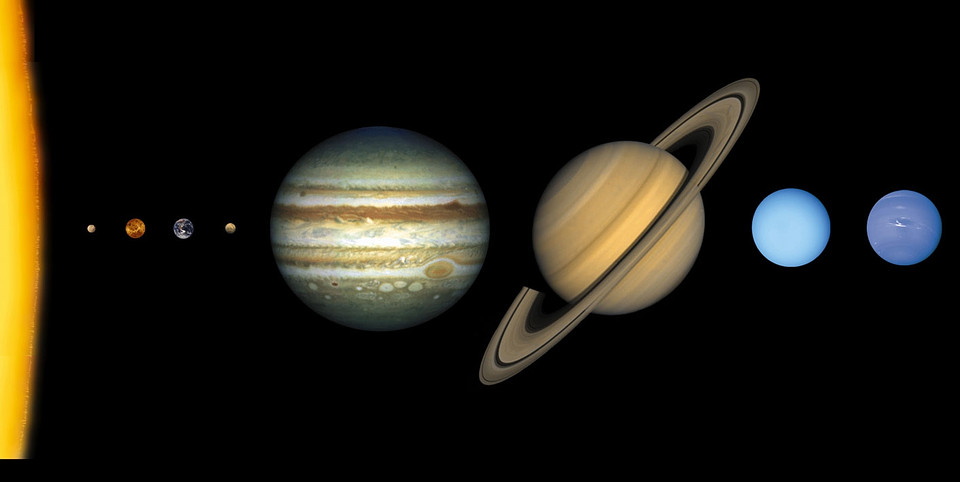
Last night I attended an event at Windsor Planetarium and Science Centre celebrating 100 years of the Planets Suite by Gustav Holst. Composed between 1914 and 1916, the original was released on 29 Sep 1918 at a time when very little was known about the planets themselves. Holst’s concept was therefore astrological rather then astronomical. These modern compositions, performed by the Ligeti Quartet, have re-imagined the characteristics of the planets from a more modern, scientific perspective.
The description of the evening from their web site was, “Inspired by modern astronomy and music, the Ligeti Quartet perform 8 new planetary works, spanning contemporary classical, electronica to jazz, created especially for planetariums.” From this description, and having never heard of the Ligeti Quartet, I was expecting a variety of different musical styles and instruments. I was slightly surprised to find it was a string quartet throughout the evening.
The composers worked with leading scientists. For each of the eight planets (Holst had only written for seven, leaving Earth out.) a composer was paired with a scientist who would mentor them and describe various facts, figures and characteristics of their allocated planet.
The evening began with a talk and presentation from Professor Carl Murray who worked on the NASA/ESA Cassini mission to Saturn. He described some of the structure of the rings and explained the hexagonal cloud pattern which persists at the north pole of the planet. It was a privilege to be able to hear from someone so closely connected with just one of the planets.
The event was marvellously staged, with the audience viewing high resolution visuals of the planets themselves above their heads while the four members of a string quartet recite from positions equally spaced around the circular walls. Each planet was introduced by a voice-over from comedian and impressionist Jon Culshaw who would describe the planet and composition followed up by a witty comment in the style of Carl Sagan, Patrick Moore or Brian Cox.
Listening to the music itself wasn’t quite what I was expecting. In my time I have listened to a lot of music which could well be described as inaccessible: from hardcore techno to Indonesian Gamelan music, but a lot of what I heard at this event went beyond any of that. I was in slight disbelief that each piece was from a different composer as many of pieces shared common elements such as intense discords, strange time signatures and aggressive playing,representing the chaos and violent characteristics of the respective planet. From the programme for the event we are told that for example: Composer Mira Calix has written her piece in 6/8 and 3/4 time signatures representing it’s 3:2 orbit:spin ratio. Or that Richard Bullen based his composition on the orbital resonance of the moon of Jupiter. All very interesting but doesn’t appeal to the listener if it ends up sounding like a bag of kittens being beaten to death with a set of bagpipes.
I am not an expert in music theory and it felt like there was little to please the casual listener. The compositions were designed to convey the facts, figures and tangible attributes of the various planets, very seldom did it feel like it tried to express the emotional attributes of the planets. Exceptions to this were the Earth composition which managed to convey a beautiful and ancient planet which has developed over time. The Mars composition featured an animation of the Mars Curiosity Rover accompanied with music which brought a sense of isolation. Aside from that, if you were to play a sample to someone without telling them what it was about, they would be unlikely to say, “Ah, that’s Uranus!”
I was slightly disappointed it was a mere 4 instruments. Don’t get me wrong, the Ligeti Quartet are immensely talented and unquestionably they faithfully conveyed the composers’ intentions, however, these instruments were all available to Holst in 1918. If the compositions are to be updated, then why not also the instruments? Where were the synthesizers, drum machines and computers?
How does this compare with Holst’s concept? Well it doesn’t really. Holst had no intention of composing music representing scientific fact, he wanted to make music which affected the psyche and conveyed the emotional characteristics of the astrological planets. Listening to his work 100 years on, this concept is still clear. He used the power and breadth of an entire orchestra to do this. Even listening to it on home speakers the drama and emotion is all there: a timeless masterpiece of work that will endure well beyond our current understanding of planetary science.
The compositions will be available to listen online at sounduk.net from 11 Oct
Links:
- Event web site: http://www.sounduk.net/events/planets-2018/
- Winchester Planetarium and Science Center: https://www.winchestersciencecentre.org/
- Ligeti Quartet: https://ligetiquartet.com/
- SoundUK recordings: https://soundcloud.com/sounduk/sets/the-planets-2018