A Short History Of Nearly Everything
created: Thu 01 February 2007 13:34:36
last updated:
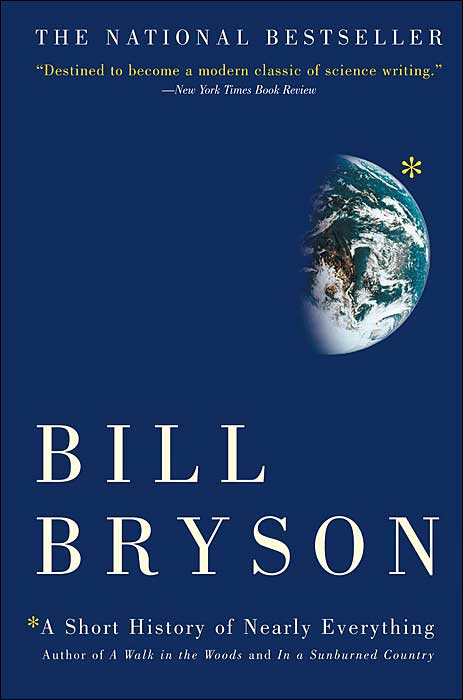 I dont read many novels. Most titles on my bookshelf fall into the categories of general science, mathematics, biographies and human endeavours, but for some reason I was never drawn to Bill Bryson's much acclaimed A Short History Of Nearly Everything. It was only after a friend told me how she had been so taken in by his incredible descriptions of how the solar system worked and the breadth of knowledge he had attempted to cover that I thought I would pick up a copy for myself.
What makes this different from other general science books I have read is the fact that Bryson is not an expert in science. In fact quite the opposite: his inspiration for this project was the fact that he was dismayed at how little he know about the world we live in and wanted to bring himself up to speed. Fair play to him, it is certainly exhaustively researched and contains a comprehensive bibliography and further reading section.
However what is missing is any passion for the subject matter. He spends a lot more time writing anecdotes about the people who made the discoveries that the science itself: A Short History of Scientists would have been a more appropriate title. The result is book, which although well written and researched, does not delve into the heart of the science. Often he deviates far from the point and over simplifies a great deal. For example at the start he goes into a detailed description of scientific notation and the explains why he wont be using it, which is a shame for those more comfortable with it than long strings of zeros all the time.
If you already have an interest in science this is going to seem a bit dry. If however you were not paying enough attention in school and want to learn about how the universe, the solar system, the earth and life itself came to be then certainly grab yourself a copy. I'll be sticking with Simon Singh...